


Pixel Control vs Segment Control for IP65 LED Wall Washers
- Quick Answer
- Pixel control and segment control solve different design problems
- Pixel and segment control decision matrix
- Start with the content scale and viewing distance
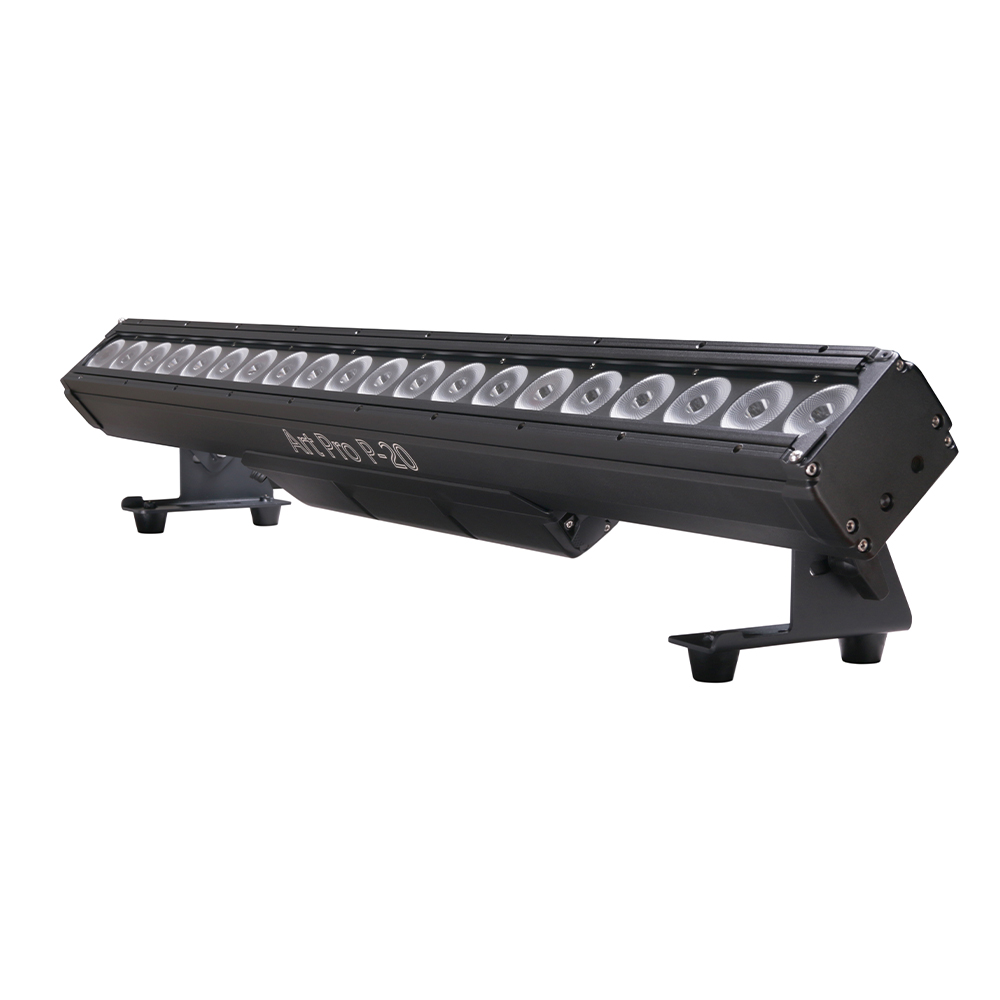
- Verified pixel-control product option
- 20x15W RGBW 4-in-1 IP65 Pixel Wall Wash Bar
- Compare control footprint and system capacity
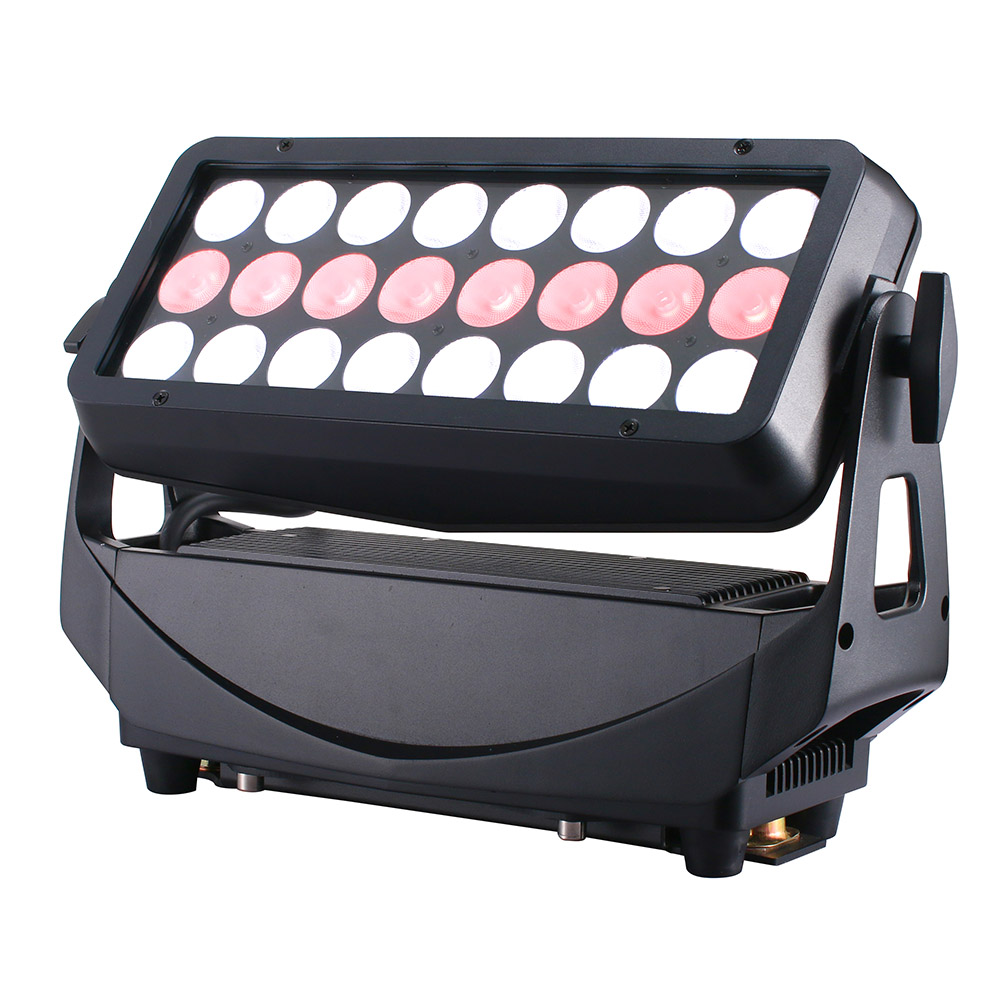
- Verified segment-control product option
- 24x20W RGBW 4-in-1 IP65 Wall Wash 6 Segments
- Plan DMX mapping before fixtures reach the site
- Evaluate color blending and boundary quality
- Select products by verified project evidence
- Design outdoor installation around serviceability
- Build effects that remain maintainable
- Use FAT and SAT to verify the complete system
- RFQ, FAT and SAT acceptance record
- Prepare an RFQ that suppliers can answer precisely
- Control change, spares and lifecycle consistency
- Conclusion
- Frequently Asked Questions
Quick Answer
Pixel control is the better fit when a project needs small independently controlled cells, detailed chases, mapped gradients or camera-visible motion. Segment control groups emitters into larger zones, reducing control footprint and programming complexity for broad facade blocks and repeatable event looks. The correct choice depends on viewing distance, surface geometry, optical blending, network capacity, operator workflow and acceptance evidence. Buyers should confirm the current channel chart and mode for the exact offered fixture instead of selecting by the words pixel or segment alone.
Pixel control and segment control solve different design problems
Pixel control assigns a separately addressable control cell to each supported LED group, while segment control combines several emitters into a larger independently controlled zone. The difference changes the kind of image, chase, gradient and transition a designer can build across a linear wall washer. Pixel control favors detailed motion and fine spatial changes, whereas segment control favors broader blocks that are easier to program and supervise. Neither architecture is automatically superior because the useful choice depends on viewing distance, facade scale, cue complexity and the operator’s available control resources.
Architectural buyers should begin with the visual requirement rather than the largest advertised channel count. A long facade seen from far away may communicate clearly with six or eight broad zones, while a stage background viewed by cameras may reveal value from smaller controllable cells. The specification should describe the desired effect in physical terms, including color-block width, chase direction, transition speed and whether multiple fixtures must behave as one continuous line. This approach lets the supplier recommend an appropriate control architecture without turning an abstract feature into an unsupported promise.
Procurement teams also need to distinguish controllable resolution from optical resolution. Two adjacent control cells may still blend on the wall when the throw is long, the beam overlaps heavily or the surface scatters light. Conversely, visible seams can appear even with many pixels if spacing, aiming or fixture alignment is inconsistent. A successful proposal therefore connects control grouping with lens behavior, fixture spacing, throw distance and the reflectance of the actual surface.
Pixel and segment control decision matrix
| Requirement | Pixel control | Segment control | Evidence |
|---|---|---|---|
| Spatial detail | Smaller controllable cells | Broader controllable zones | Sample effect at viewing distance |
| Control resources | Usually higher footprint | Usually simpler footprint | Current channel chart |
| Programming | Detailed mapping | Broad block cues | Approved cue list |
Start with the content scale and viewing distance
The smallest useful lighting detail should be large enough for the audience to perceive from the intended position. Buyers can sketch the facade elevation, mark typical viewing points and define the minimum color block that must remain recognizable. That block can then be translated into a target number of controllable zones across each run, allowing fixture selection to follow a visible requirement. This prevents a project from purchasing dense pixel control that disappears at distance or choosing broad segmentation that cannot reproduce the approved creative concept.
Camera use changes the calculation because a lens may isolate a smaller portion of the installation than a live audience sees. Close shots can expose abrupt boundaries, uneven gradients and timing offsets that remain invisible from the rear of a venue. When broadcast or recording matters, the test should include the planned camera angles, frame rates and exposure conditions rather than relying only on an audience-view inspection. A sample run photographed from those positions provides more reliable evidence than a generic product demonstration.
Surface geometry must be included because columns, recesses, joints and reflective panels interrupt the apparent continuity of a wall wash. A control cell that spans a deep architectural break may create two visually disconnected patches even though the DMX data treats them as one zone. Mapping zones to physical features can make a lower-resolution segmented system look intentional and coherent. Ignoring those features can make a higher-resolution pixel system look noisy or misaligned despite technically correct control.
Verified pixel-control product option
Compare control footprint and system capacity
More independently controlled cells generally require more control data, although the exact footprint must be confirmed from the current channel chart for the offered model and mode. The designer should calculate the real slots used by one fixture, multiply by the quantity and then reserve capacity for other systems, test addresses and future service substitutions. A patch that barely fits on paper can become fragile when a later firmware mode or replacement fixture uses a different footprint. Capacity planning should therefore include a documented margin rather than consuming every available address.
Universe count is only one part of the infrastructure decision. Nodes, splitters, network switches, cable routes and console processing all need to support the final distribution plan without undocumented merges or duplicated addresses. Larger systems benefit from grouping fixtures by physical run and keeping naming consistent between the elevation, patch sheet and console. This structure simplifies commissioning because a technician can isolate one line, one output or one fixture family without disturbing the entire installation.
Segment modes can reduce data and programming complexity when the creative brief uses broad color zones, while pixel modes can justify their larger footprint when detailed chases or mapped patterns are required. A buyer should ask the supplier to identify every available mode and the function of each channel, but should not assume that the longest mode is the correct one. The selected mode should be recorded in the RFQ, factory test and handover documents. Keeping the choice consistent across a fixture type protects later cue editing and replacement work.
Verified segment-control product option
Plan DMX mapping before fixtures reach the site
A control map should show how logical cells relate to physical emitters and installed orientation. If a linear fixture is rotated, reversed or installed from the opposite end of a run, the first control cell may appear on the unexpected side. The commissioning team should establish a left-to-right reference, label each fixture and test a single-cell chase before building complex cues. This simple procedure catches orientation errors that would otherwise be hidden inside the programming file.
Fixture order must match the visual order of the installation. Addressing by delivery sequence or carton number can create confusing jumps when the physical positions differ from the patch. A controlled schedule should list fixture ID, run, location, orientation, universe, address, mode and expected first cell. The same identifiers should appear on drawings, labels and console groups so troubleshooting does not depend on one technician’s memory.
Mapping tests should begin with primary colors, white output and a slow chase that activates one zone at a time. This exposes reversed order, skipped cells, duplicated addresses and incorrect mode selection without the visual noise of a finished effect. After the basic map is correct, test gradients, crossfades and synchronized movement across fixture boundaries. Saving these diagnostic cues gives maintenance teams a repeatable way to check the system after service or replacement.
Evaluate color blending and boundary quality
Pixel and segment control are valuable only when adjacent zones blend in a way that supports the design. Lens distribution, emitter spacing, mounting distance and surface texture determine whether boundaries look smooth, deliberately sharp or uneven. Buyers should define whether the project wants visible graphic blocks or a continuous gradient because those outcomes require different spacing and programming choices. A sample test should use the intended wall material or a representative surface rather than a small white screen placed close to the fixture.
RGBW mixing adds a dedicated white component, but the usable result still depends on calibration, optical mixing and cue values. Two fixtures with the same color command may appear different if their thermal condition, aging, optics or manufacturing variation differs. Batch comparison should include white, saturated colors, low-level fades and mixed pastel tones across multiple units. Any correction should be documented so the final show file does not hide a hardware or setup inconsistency that returns after reset.
Boundaries across separate fixtures deserve special attention because mechanical spacing can create a dark gap or an overlap brighter than the rest of the run. Pixel control cannot correct a large physical gap, and segment control cannot conceal poor aiming. Installers should use a repeatable reference distance and alignment method, then evaluate the transition from several audience positions. The acceptance record should distinguish mechanical correction, fixture setting and console correction so later maintenance preserves the approved result.
Select products by verified project evidence
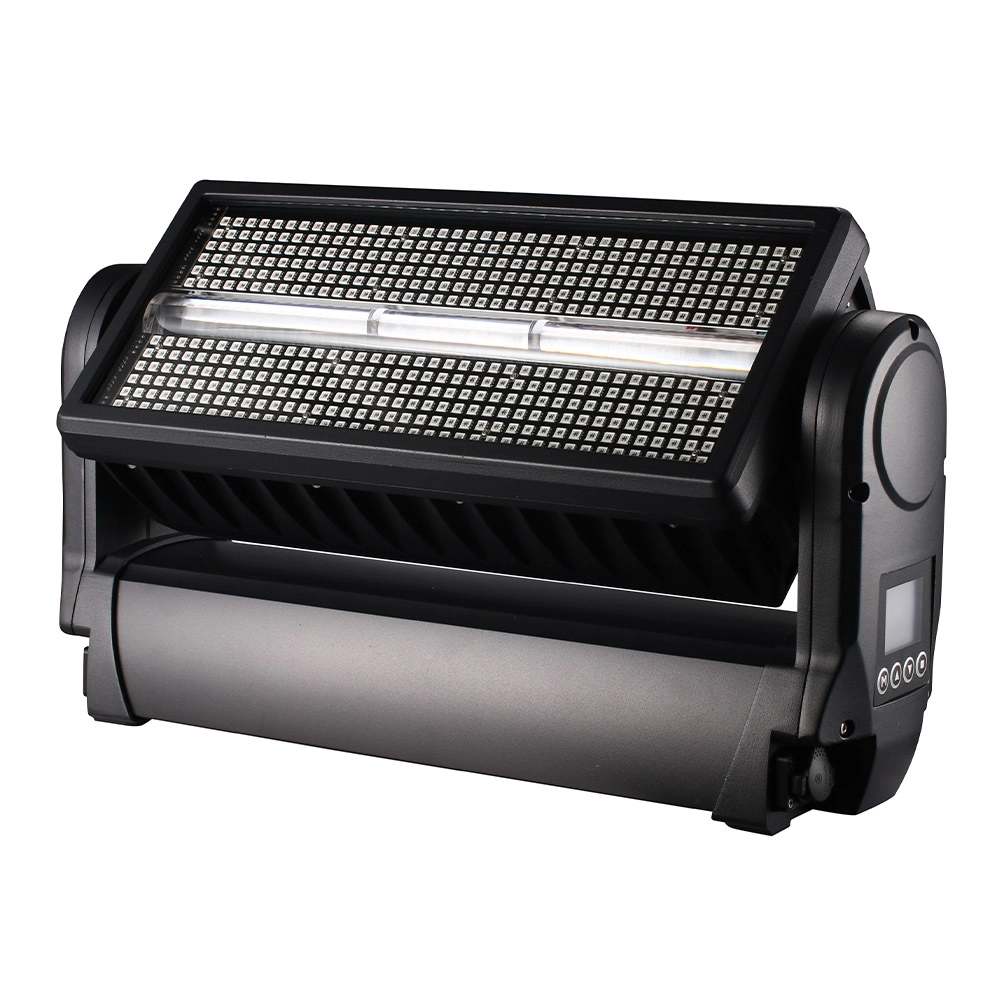
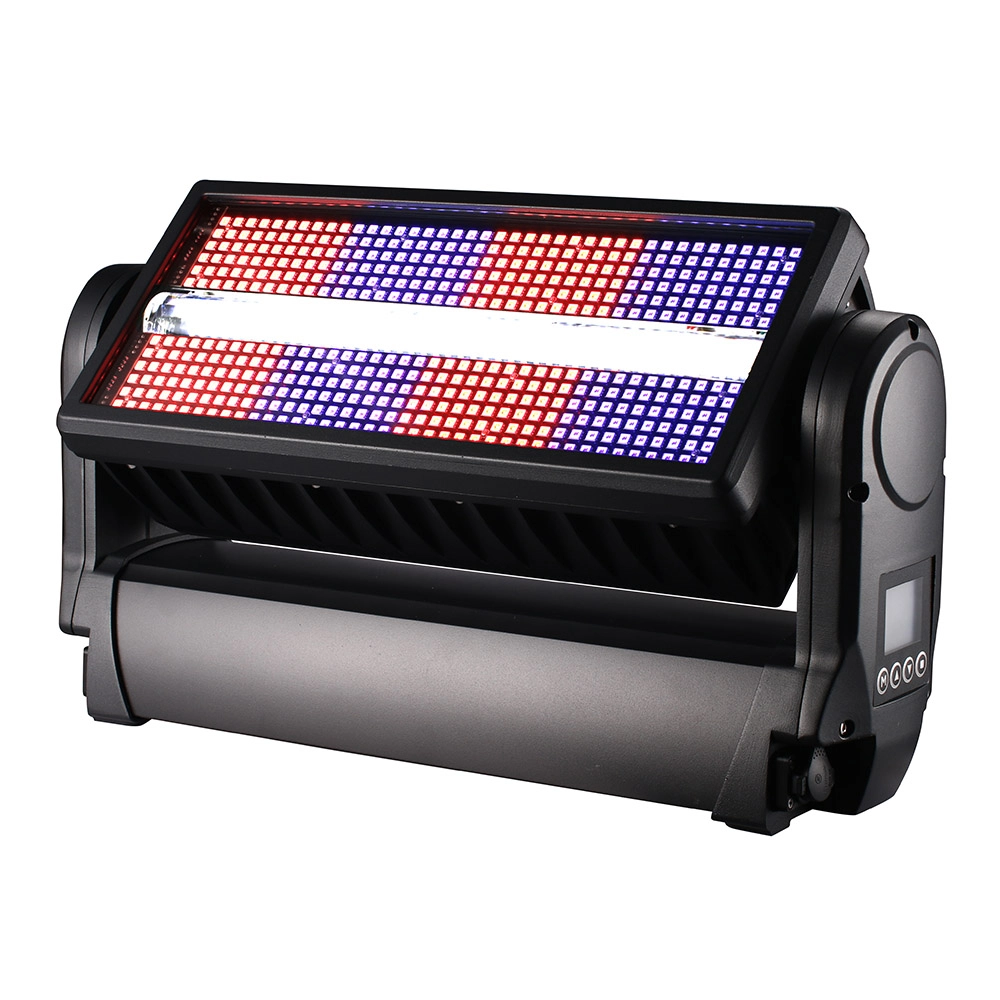
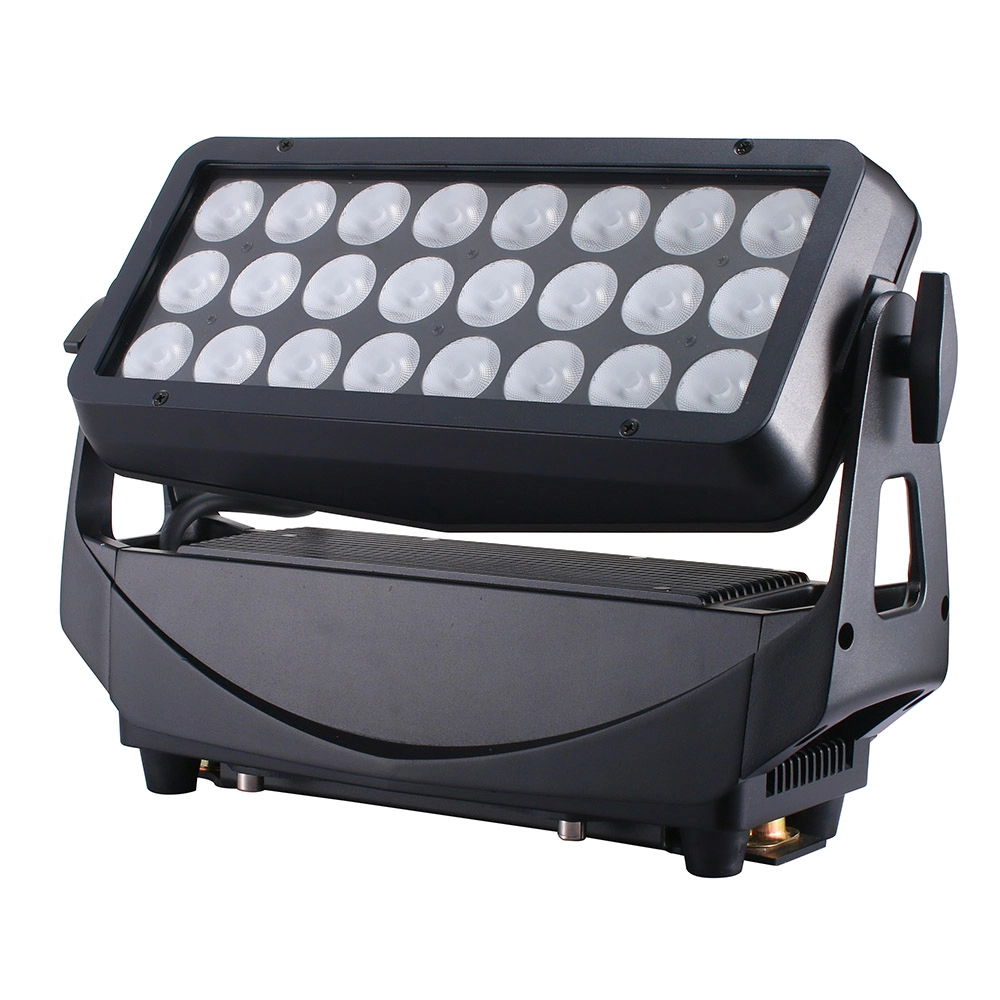
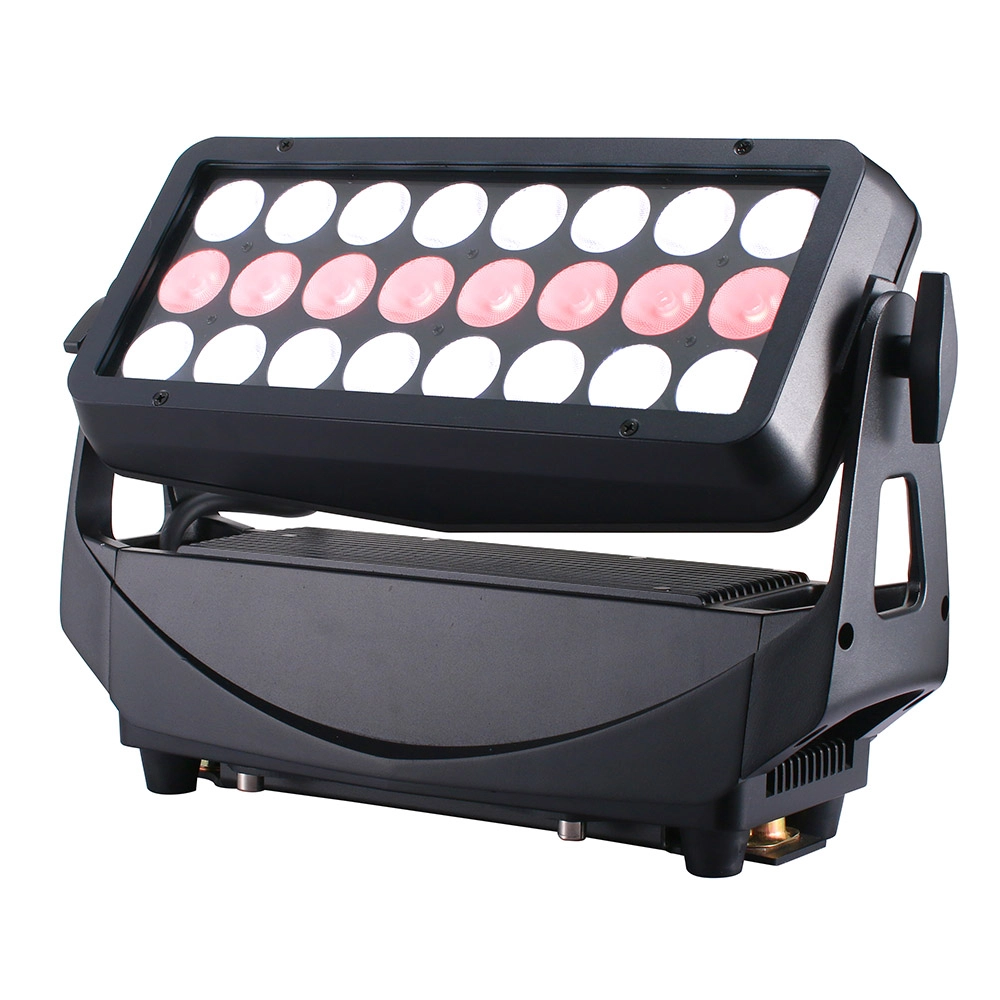
The 20x15W RGBW 4-in-1 IP65 Pixel Wall Wash Bar is documented as supporting pixel-level independent light control and DMX512, making it relevant when the project requires fine linear effects. The 24x20W RGBW 4-in-1 IP65 Wall Wash 6 Segments provides a larger six-segment structure for broader controlled zones. These published distinctions support a practical comparison, but the final channel footprint and operating modes should still be confirmed for the offered production version. A buyer should request the current channel chart rather than transferring assumptions from another model or an earlier firmware release.
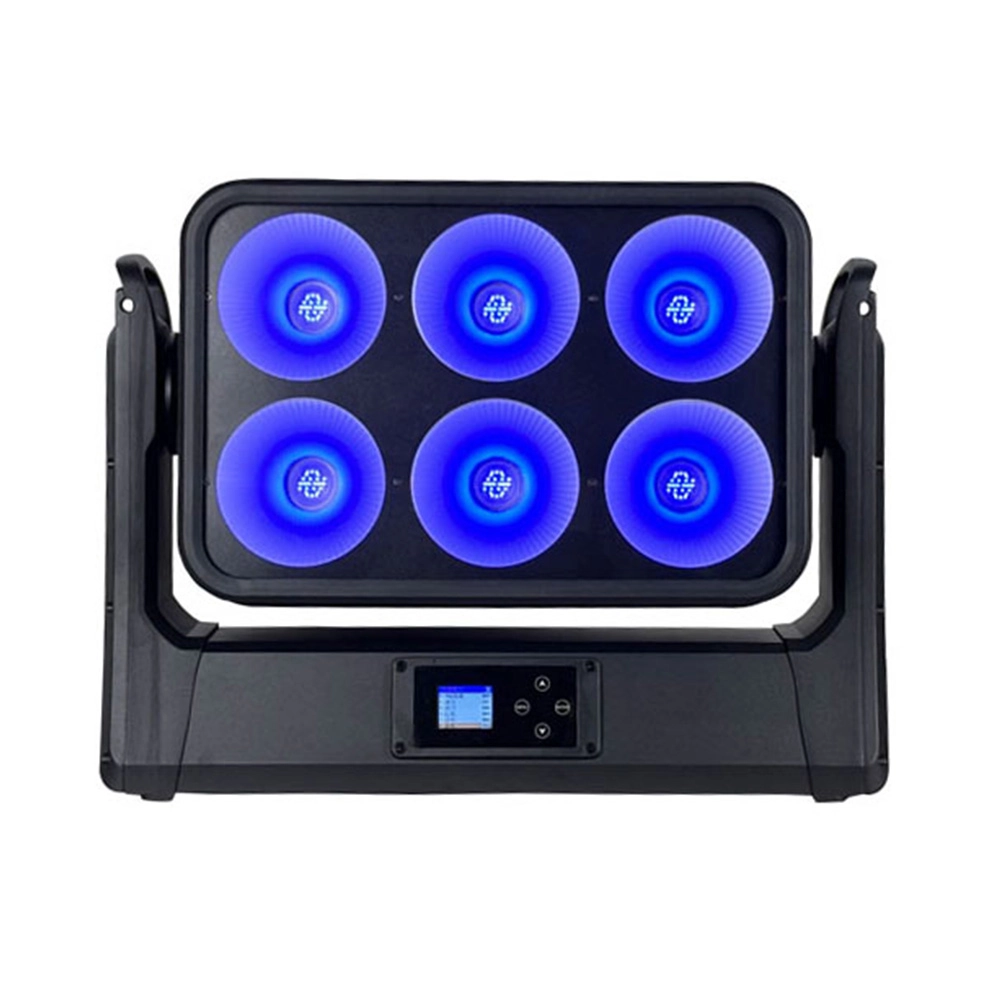
The 24x15W RGBW 4-in-1 IP65 Moving Head Wall Washer Light adds controlled positioning to an outdoor wash format, which changes the planning problem from a fixed linear run to a movable wash system. Its product record identifies DMX512 control, RGBW emitters and an IP-rated outdoor design. Positioning capability can be useful for changing scenic targets, but it also introduces movement calibration, clearance and repeatability checks that fixed bars do not require. It should therefore be evaluated as a related option rather than treated as a direct substitute for every fixed pixel or segmented bar.
Product selection should remain tied to the approved effect list, installation constraints and maintenance plan. A detailed pixel bar may be appropriate for mapped stage scenery, while a segmented wash can be more efficient for broad facade zones and a moving-head washer can support changing targets. The RFQ should identify which role each fixture serves and which evidence will be used to accept it. This prevents a visually impressive demonstration from displacing the actual functional requirements of the project.
Design outdoor installation around serviceability

An IP65 product rating supports outdoor use under the conditions covered by the product design, but the installation still requires responsible connector, cable, drainage and mounting practices. Cables should form managed routes that avoid standing water, sharp edges, tension and movement against the fixture body. Connections need the correct mating parts and sealing method, and unused ports should remain protected as specified by the manufacturer. The site team should inspect the complete installed system because an enclosure rating does not automatically protect an incorrectly assembled connection.
Access planning is especially important in long pixel-controlled runs because a single fixture or cell problem can interrupt a continuous visual sequence. Installers should preserve enough space to remove a unit, inspect connectors and verify an address without dismantling unrelated sections. Labels must remain readable after installation and should correspond to the patch and elevation. A serviceable layout reduces downtime and lowers the risk that an emergency replacement is installed with the wrong orientation or control mode.
Thermal conditions should be observed during realistic output and ambient conditions. Color consistency, output and electronic behavior can change as fixtures warm, so a brief power-on check is not equivalent to an endurance observation. The acceptance plan can include a sustained representative cue followed by color, cell and communication checks. Any site-specific limits should be documented without inventing a universal operating threshold that has not been verified for the offered model.
Build effects that remain maintainable
Detailed pixel programming can create distinctive motion, but every effect adds operational dependencies. A show file should use clear groups, palettes and presets so changes to one fixture family do not require editing hundreds of raw channel values. Reusable building blocks also make it easier to adapt the effect when a run length changes or a temporary replacement is introduced. Programming quality should be evaluated by how reliably the system can be operated and serviced, not only by the complexity of one demonstration.
Segmented control often produces strong results with fewer programming layers when the design uses large color fields, rhythmic blocks or directional chases. The operator can build cues that remain understandable to another technician and easier to reproduce across venues. Simplicity is not a limitation when it matches the visual brief. A stable six-zone design can be more valuable than a dense pixel map that only its original programmer can repair.
Both approaches benefit from reference cues that test all cells, all primary colors, white, low-level fades and full-run synchronization. These cues should be separated from creative playback and retained in the handover package. Maintenance teams can then identify whether a complaint relates to an emitter, a control cell, an address, a data path or the creative cue. Fast diagnosis protects event schedules and prevents unnecessary fixture replacement.
Use FAT and SAT to verify the complete system
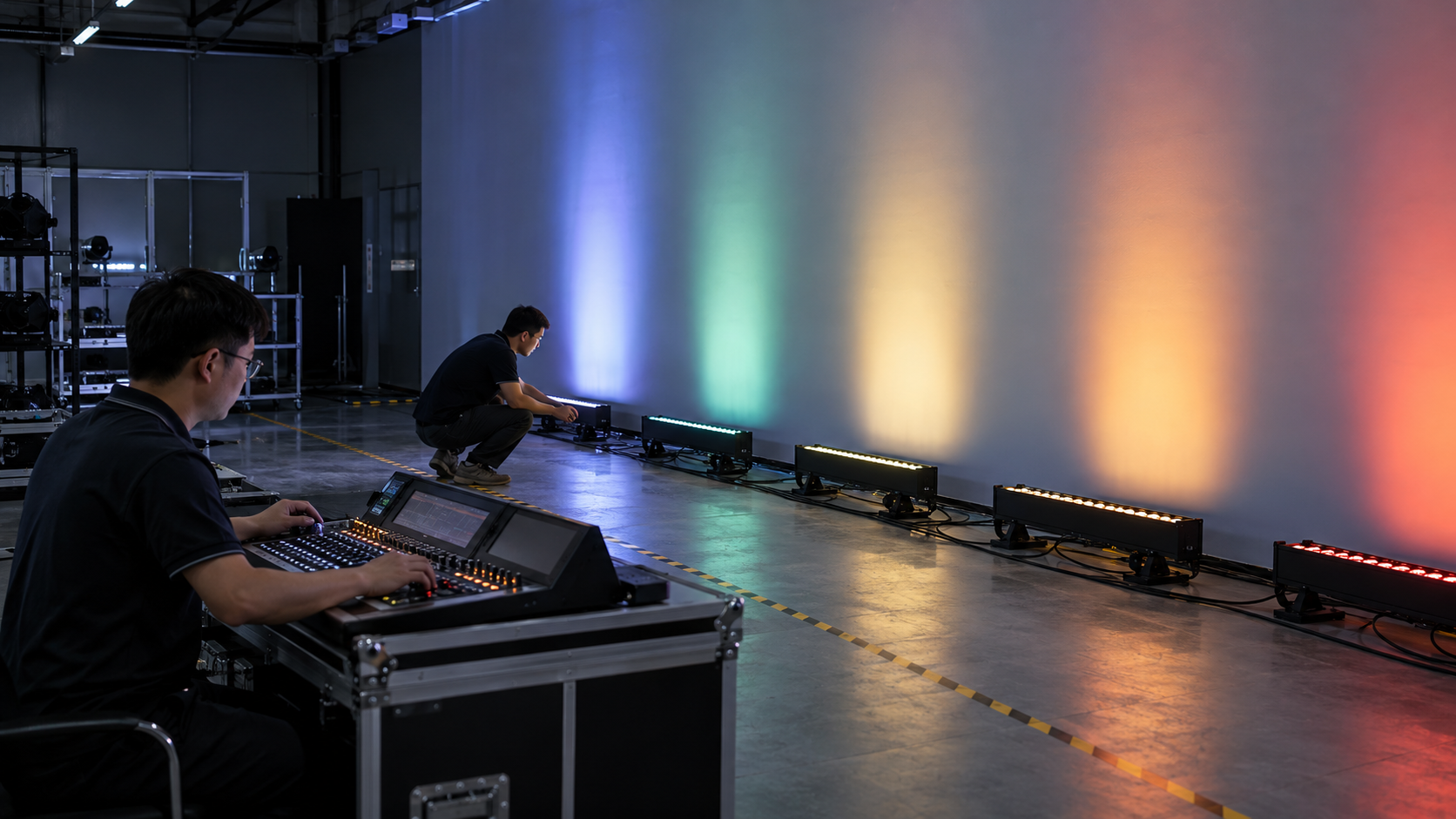
Factory acceptance testing should confirm identity, quantity, physical condition, current documentation and the selected control mode before creative effects are judged. The test should activate each pixel or segment in order, verify color response and check that fixtures recover correctly after a power cycle or approved reset. A fixed-camera recording can preserve evidence when the target and fixture labels are visible. The report should state the tested model, sample quantity, mode, firmware identification and control source.
Site acceptance testing should repeat the mapping checks through the installed network and then evaluate the actual throw, surface and viewing positions. The team should verify fixture order, address, orientation, mounting, connection protection and the transition across fixture boundaries. Creative cues should be loaded only after the diagnostic sequence passes. This order separates installation faults from programming choices and creates a clear record for corrective work.
Final approval should include a controlled document package containing drawings, patch, mode list, channel chart, fixture labels, profile files, test cues and service notes. Operators need to know which files are authoritative and how revisions are named. If a setting changes after acceptance, the reference tests should be repeated and the record updated. Documentation turns a successful opening night into a maintainable system rather than a one-time demonstration.
RFQ, FAT and SAT acceptance record
| Stage | Check | Record |
|---|---|---|
| RFQ | Model, mode, grouping, optical role | Compliance matrix |
| FAT | Cell order, colors, reset, documents | Test sheet and video |
| SAT | Installed map, blending, network, access | Signed handover pack |
Prepare an RFQ that suppliers can answer precisely
The RFQ should describe the facade or stage dimensions, viewing distances, surface, mounting location, expected weather exposure and required visual effects. It should state whether the design needs per-pixel control, a defined number of segments or only uniform full-fixture output. The buyer should request the current mode and channel documents for the offered model, not a generic family brochure. Providing these details allows suppliers to compare appropriate equipment instead of guessing from a short product name.
Commercial questions should be linked to technical acceptance. Quantity, packing, spare units, labeling, documentation and test evidence all influence whether the delivered system can be commissioned efficiently. The RFQ can request a sample or pre-production confirmation when mapping and optical blending are critical. Any claim about capacity, compatibility or outdoor performance should be tied to the actual offered configuration and evidence available for review.
Bid comparison works best when every supplier responds to the same evidence schedule. A matrix can record product identity, control architecture, verified modes, data footprint, optical options, mounting approach, connector plan, sample result and handover documents. Unsupported statements should be marked for clarification rather than treated as equivalent to verified information. The award decision can then balance creative capability, infrastructure cost, installation risk and long-term serviceability.
Control change, spares and lifecycle consistency
A wall-wash installation may operate for years while consoles, nodes, spare fixtures and creative files change around it. The owner should preserve one approved profile, one diagnostic show file and one record of the selected mode for each fixture type. When a replacement unit arrives, technicians can compare its firmware, channel chart and cell order against that baseline before assigning the original address. This process prevents a visually similar spare from introducing reversed pixels, different segment grouping or an unexpected data footprint during a time-sensitive event.
Spare planning should reflect the role of each product rather than relying on a single generic percentage. A continuous pixel line may justify a configured spare that can be installed with the approved orientation and mode, while a segmented facade zone may require matching optics and housing to preserve visual balance. Store mounting hardware, protected connectors and labeling materials with the fixture so replacement work does not compromise the original installation. After any substitution, rerun the cell-order, primary-color, white-output and boundary-blending cues before returning the run to service.
Software changes need the same discipline as physical replacements because a revised personality can alter attribute mapping without changing the fixture. Test profile updates in a controlled copy of the show file and compare several stored cues before applying them to the production system. Record the reason, date, profile revision and fixtures checked, then retain the previous approved version for recovery. Lifecycle control protects the creative investment and gives suppliers meaningful evidence when a reported issue must be separated into programming, network, configuration or hardware causes.
Conclusion
Pixel control provides finer spatial control for detailed chases, gradients and mapped effects, while segment control provides broader zones that can reduce data and programming complexity. The best choice follows the visible design requirement, viewing conditions, facade geometry and operating resources rather than a simple preference for more channels. Optical blending, physical spacing and mapping quality remain essential in both architectures. Buyers should validate the complete chain from fixture and mode to network, programming and installed surface.
A disciplined project converts the selected architecture into a documented patch, repeatable diagnostic cues and clear factory and site tests. Product evidence should be checked model by model, especially when pixel, segmented and moving-head wall washers serve different roles. The handover package should preserve profiles, firmware records, fixture identities and acceptance observations for later maintenance. With these controls in place, the wall-wash system can deliver the intended visual detail without creating unnecessary operational risk.
Frequently Asked Questions
What is the main difference between pixel and segment control?
Pixel control provides smaller independently controlled cells, while segment control groups emitters into larger zones. The useful choice depends on the visual effect, viewing distance, control capacity and maintenance workflow.
Does more pixel control always produce a better wall wash?
No. Optical overlap, fixture spacing, throw distance, surface texture and programming determine what the audience sees. Extra control cells add value only when the design can use and maintain them.
How should buyers compare channel requirements?
Request the current channel chart and mode list for the exact offered model and firmware. Calculate the complete fixture quantity, universe allocation, network outputs and a practical spare margin.
Can segment control create dynamic effects?
Yes. Segmented fixtures can create color blocks, directional chases, rhythmic transitions and gradients across larger zones with a simpler control footprint than dense pixel mapping.
What should be checked during factory acceptance?
Verify product identity, selected mode, cell or segment order, color response, reset behavior, documentation and repeatability. Record the control source, firmware identification and tested sample quantity.
What should be included in the handover package?
Include drawings, fixture labels, patch, channel charts, profile files, firmware records, diagnostic cues, test results and service notes so later maintenance starts from the approved baseline.



◼
Product Recommendations
You May Also Like

◼
Get in Touch
Get Started with Stage Lighting Project
Want to transform your stage or venue with Colorful Light?
Explore our solutions and let us create a memorable lighting experience for your event.
Colorful Light is a professional LED stage lighting manufacturer that provides dynamic and reliable lighting solutions to customers worldwide.
© 2026 Colorful Light. All Rights Reserved.

Facebook
Instagram
LinkedIn
YouTube
Tik Tok